Transmission Control Protocol (TCP):
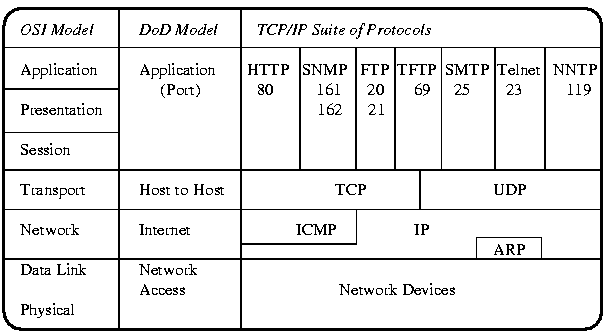
TCP is the transport layer of the protocol and serves to ensure a reliable, verifiable data exchanged between hosts on a network. TCP breaks data into pieces, wraps the pieces with the information needed to identify it as a piece of the original message, and allow the pieces to be reassembled at the receiving end of the communications link. The wrapped and bundled pieces are called Datagrams (or segments).

 The network layer portion of the DoD model is called the Internet layer. The main protocol at this layer is the Internet Protocol (IP). IP is considered connectionless; i.e; it does not swap control information in order to establish an end to end connection before starting a transmission. This is known as best effort transmission. and if a packet is lost in transmission, IP must rely on TCP to determine it the data did not arrive successfully.
Address Resolution Protocol (ARP) :
 The network layer protocol, ARP, associates the physical hardware address of a network node to its already known IP address. Using ARP, an IP process construct a table that maps ip addresses to mac addresses of nodes on LAN. When a node needs to send a packet to a known IP address on local sub-net, it first checks the ARP cache to see it the physical address information is already present. If so, that address is used and network traffic is reduced.
Internet Control Message Protocol (ICMP) :
It works at the network layer and provides the functions used for Network layer management and control. Routers send ICMP messages to respond to undeliverable datagrams by placing an ICMP message in an IP datagram and then sending the datagram back to the original source. The PING command.
User Datagram Protocol (UDP) :
 It is a transport layer connectionless protocol that does not provide the reliability services with TCP but provides best effort transmission services to application protocols.It gives applications a direct interface with IP and the ability to address a specific application protocol running on a host via a port number without setting up an end-to-end connection.
TCP is the transport layer of the protocol and serves to ensure a reliable, verifiable data exchanged between hosts on a network. TCP breaks data into pieces, wraps the pieces with the information needed to identify it as a piece of the original message, and allow the pieces to be reassembled at the receiving end of the communications link. The wrapped and bundled pieces are called Datagrams (or segments).
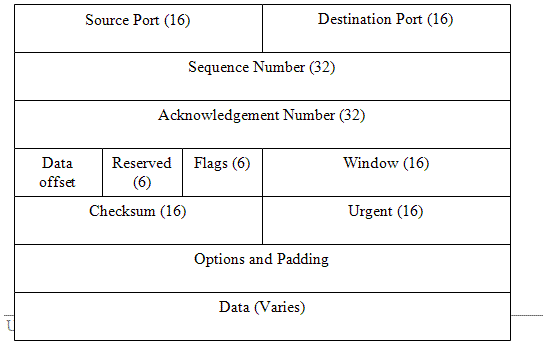
- Source port and Destination port ensure that data is sent back and forth to the correct application process running on each machine.
- Segment Number allows datagrams to be rebuilt in the correct order in the receiving device, and checksum allows the protocol to check whether the data sent is same as data received.
- Acknowledgement number indicates that the data was received successfully, and Offset specifies the length of the header in 32-bit chunks.
- Reserved specifies variables that are set aside for future use, it must contain ZEROS, and Flags , these are six one-bit fields that indicate various things, like whether segment is end of higher-layer message, acknowledgement number is significant, sender is requesting that a virtual circuit, data in the segment is urgent.
- Window provides a way to increase the number of segments transmitted before the sender excepts an acknowledgement, and Urgent gives the location where the urgent data ends.
- Options and Padding communicates various parameters of TCP virtual circuit, like maximum segment size, and it also ensures that the header ends on a 32-bit boundary so that the offset field makes sense as a whole number.

Address Resolution Protocol (ARP) :

Internet Control Message Protocol (ICMP) :
It works at the network layer and provides the functions used for Network layer management and control. Routers send ICMP messages to respond to undeliverable datagrams by placing an ICMP message in an IP datagram and then sending the datagram back to the original source. The PING command.
 |
| ICMP EXAMPLE |
User Datagram Protocol (UDP) :